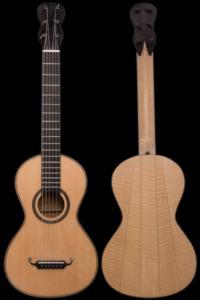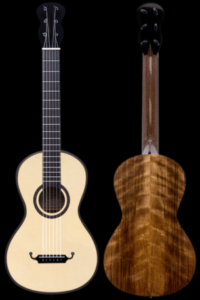
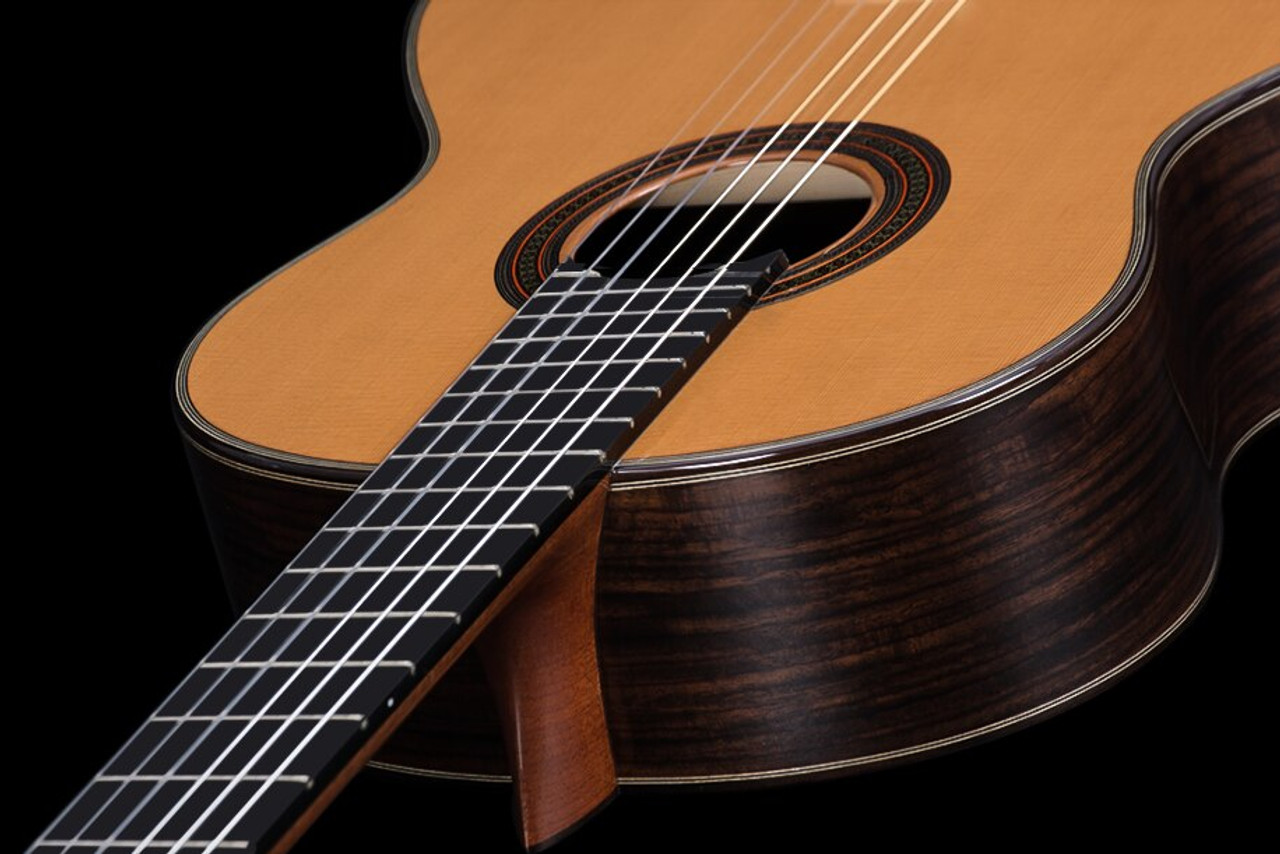

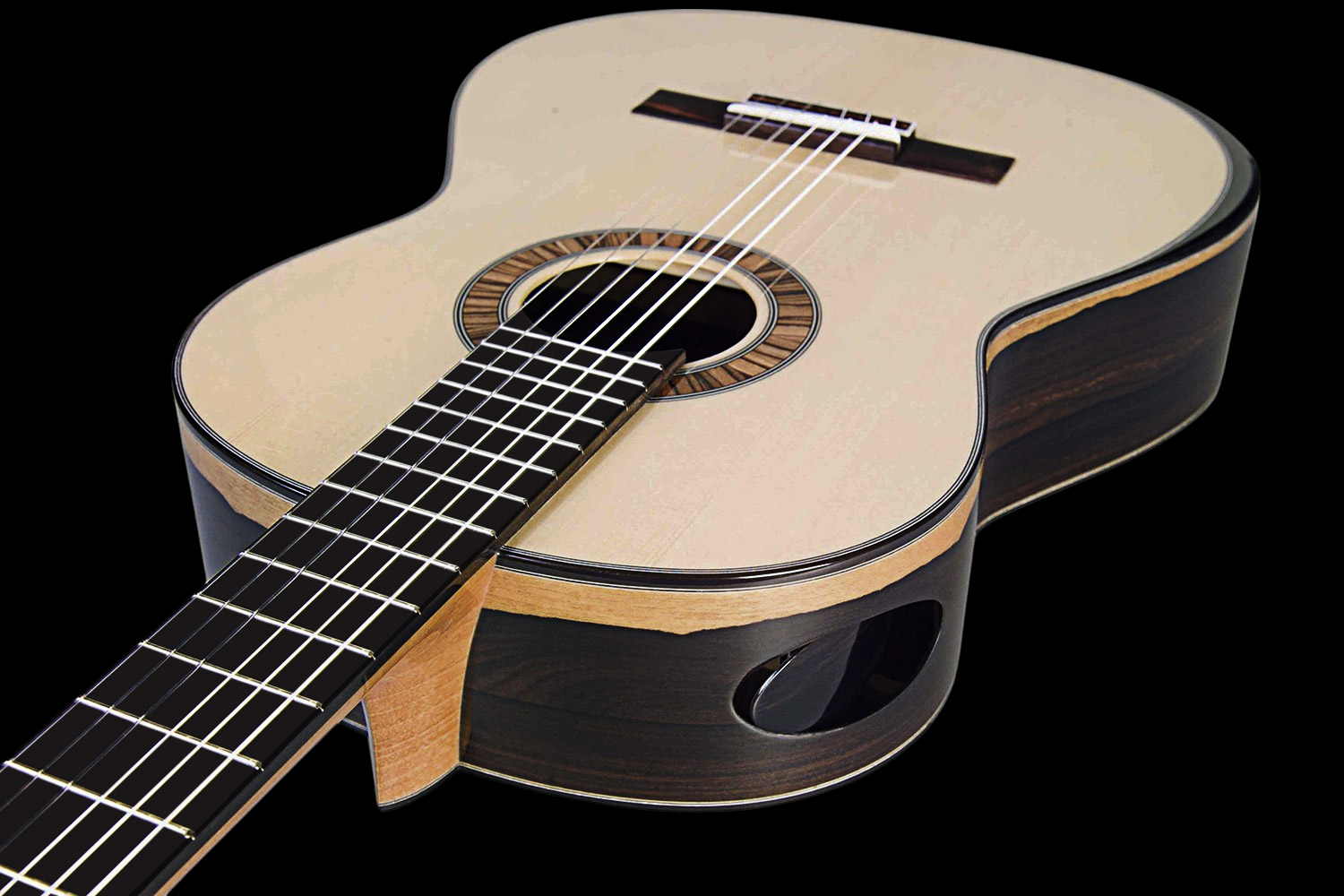
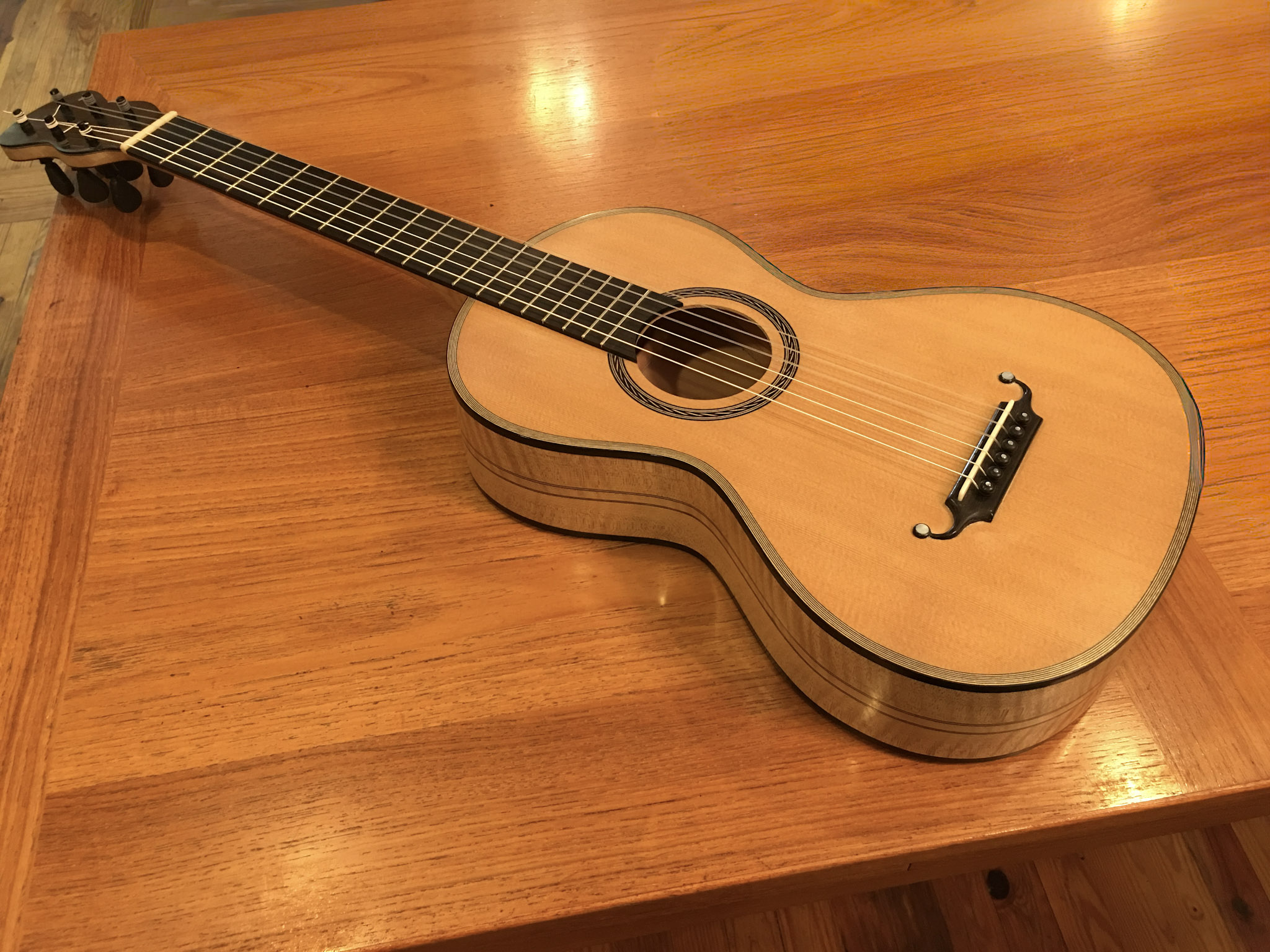

I strive to honor the spirit of the originals while building instruments that are more reliable, more serviceable, and more musically rewarding for todayâs players. LacĂ´te and his contemporaries worked with the tools and materials of their time, often relying on delicate glue joints, shallow mortise-and-tenon connections, and a surprising amount of improvisation. Some builders even drove nails through the heel; Stauffer engineered an ingenious neck-adjustment mechanism. I take inspiration from their creativity but choose a different path. I use a modern bolt-on neckâclean, precise, and mechanically secure. The fretboard is still glued with hide glue in the traditional way, but the joint is intentionally releasable. If the guitar ever needs work, the neck comes off cleanly without a fight.
At the bench, Iâve learned that small decisions in bracing make enormous differences in how the top speaks. Romantic guitars lean heavily on ladder bracing and sensitive top thicknessing; thatâs where so much of their charm and character come from. But thereâs room to guide that voiceâto shape the attack, the warmth, the way the notes bloom. I adjust brace height, thickness, and scalloping until the top feels alive under my fingers. I experiment with top woods, too. Sitka often brings out a slightly ânasalâ focus with sharper bassesâvery reminiscent of earlier, lute-like instruments. Alpine spruce, by contrast, tends to open into a warmer, sweeter sound. Both are valid; both can be beautiful. The craft lies in matching the material to the musical personality Iâm aiming for.
Volume is another area where Iâm willing to rethink tradition in order to serve the player. These small-bodied Romantic guitars can be surprisingly powerful if you give the top the right kind of support. My laminated sides arenât plywood; theyâre a carefully bonded spruce-and-hardwood composite, built to be rigid. Paired with a laminated back, the result is a stiff, efficient frame that lets the soundboard do its job. I wonât claim any single innovation is responsible, but experience has shown me that this approach consistently yields guitars with presence and projection well beyond their size. Thatâs proof enough for me to keep building this way.
When I build a maple neck, I bookmatch the two halves of the neck shaftânot just for appearance, but for stability. A bookmatched maple neck is inherently more resistant to movement, and the symmetry of the grain gives the instrument a refined, intentional look. My volute design follows the same philosophy. It isnât just an aesthetic flourish; itâs engineered to increase the gluing surface between the neck shaft and the headstock. Between the volute itself and the way both the front and back headstock plates overlap the joint, the entire assembly is dramatically strengthened. I wanted a volute that worked hard and looked good doing itâfunctional, distinctive, and instantly recognizable. I believe Iâve achieved that balance.
The neck-to-body connection carries similar intent. Many Romantic-era guitars used little more than a shallow mortise, and some had no mortise at allâjust a heel glued to the body, sometimes reinforced with a single screw or nail. My approach is considerably more robust. I use a true tenon that seats deeply into a precision-cut mortise, locked in place with a pair of specialized furniture bolts. This creates a neck joint that is exceptionally stable, reliable under tension, and far more resistant to shifting over time. The result is consistent intonation, a geometry that holds, and a structural integrity that supports the guitar through decadesânot just yearsâof playing.
Pegheds planetary tuners have become a cornerstone of my builds because they solve real problems without compromising the period look. Traditional friction pegs can be charming, but theyâre also stubborn, inconsistent, and often require more patience than most players care to give. Pegheds change all of that. They preserve the classic silhouette of a 19th-century peg while delivering effortless, one-hand tuning and extremely sensitive micro-adjustment. The guitar stays in tune, the player stays relaxed, and the instrument maintains its historical aesthetic without the drawbacks.
And since the headstock is already a focal point of the instrument, I treat it with the same blend of tradition and personal signature. Where many LacĂ´tes used a simple hardwood faceplate, I build a more distinctive black-white-black sandwich by layering natural maple with a dyed-black veneer. Itâs subtle enough to sit comfortably within the Romantic lineage, yet unmistakably mine. Paired with Pegheds, the headstock becomes both a functional upgrade and an aesthetic statementâa perfect example of how I merge historical inspiration with modern craftsmanship.
I keep the details clean and monochromatic, echoing the understated elegance of the period, but the instrument gives me space to put my own fingerprint on the design. The back, on one of my models, for example, is a book-matched five-piece layoutâmy signature patternâcarefully selected and joined so the grain lines flow in a deliberate, balanced rhythm. The sides follow suit: a two-piece laminated construction with a decorative purfling strip that adds both refinement and a sense of continuity across the body. These are conscious choices, not embellishments for their own sake, but aesthetic markers that say, âThis is a Marfione.â
This is how I approach the craft: respect the past, embrace what genuinely works, and make thoughtful decisions that serve the player first. Romantic guitars deserve to be more than museum pieces. In the right handsâand built with the right balance of tradition and innovationâthey come alive.
Custom Built Nylon String Guitars, Retail Sales, Repairs/Restorations & Setups
Book A Free Consultation Today!