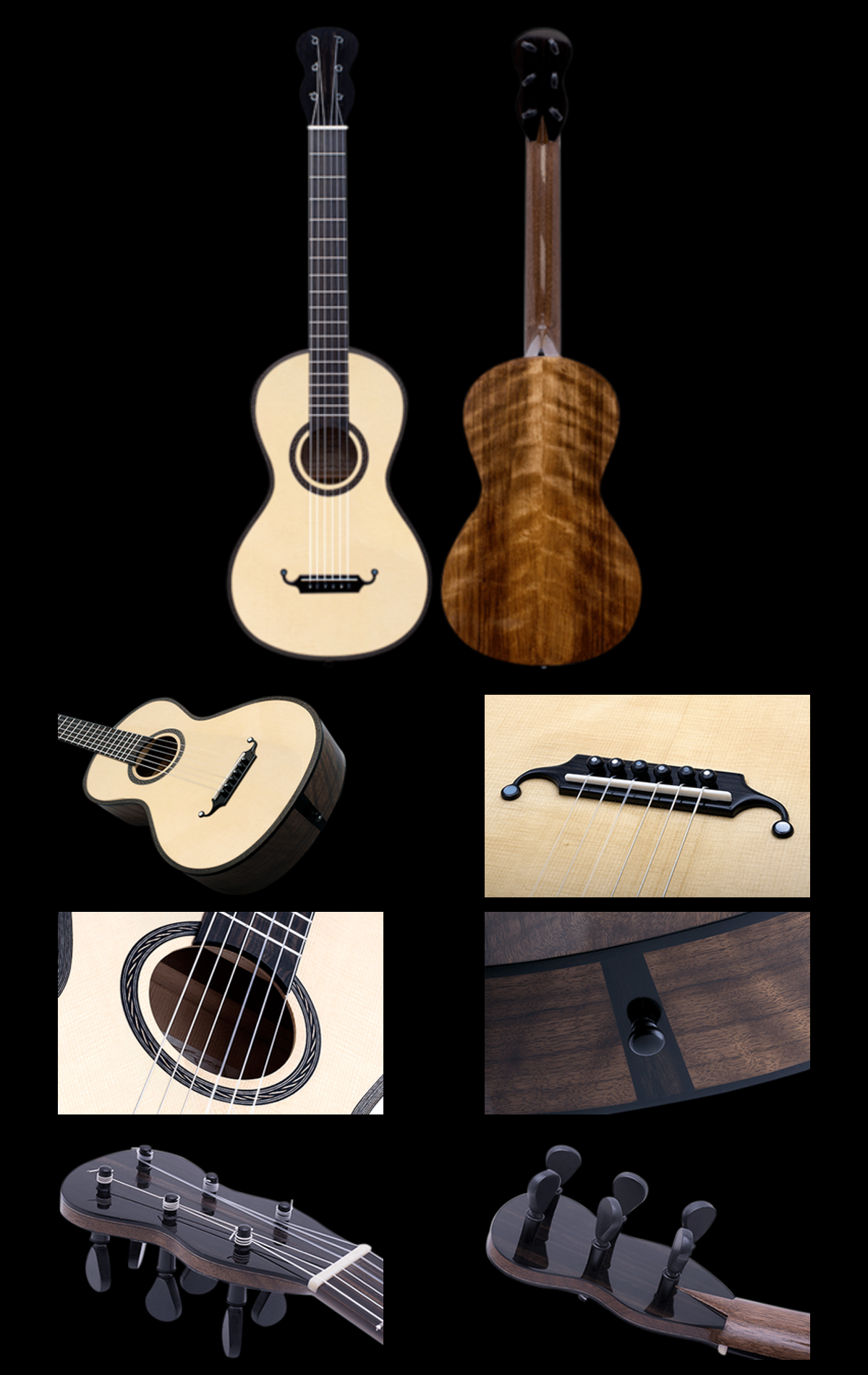
My Lacote Curly Walnut Romantic Guitar is rooted in early 19th-century French guitar traditions, but built for modern players and modern environments. Rather than replicating a single historic instrument, this model focuses on the feel and tonal clarity associated with the work of René Lacôte.
At the same time, I incorporate subtle structural and aesthetic refinements that support long-term stability, serviceability, and visual balance. The result is a Romantic guitar that respects historical design principles while remaining reliable and practical for contemporary use.
Visually, the guitar is restrained and purposefully built. Material quality, balance, and responsiveness take priority over ornamentation.
For this model, I selected Australian curly walnut for its color, controlled figure, and consistency from set to set.
Curly walnut offers a strong balance of warmth, clarity, and tonal depth that suits the Romantic guitar voice well. Compared to maple, walnut tends to produce a rounder midrange while retaining the quick response and articulation needed for early repertoire.
The backs and sides of my Lacote Curly Walnut guitars use a layered construction designed to combine light build weight with long-term stability. Each set begins with a thin inner layer of high-grade Sitka spruce, followed by a layer of vulcanized fiber, and finished with an outer layer of Australian curly walnut.
This structure helps the instrument remain lightly built—an essential characteristic of early 19th-century Romantic guitars—while improving dimensional stability across seasonal changes. The vulcanized fiber core adds strength without unnecessary mass and allows the sides to remain thin while helping to isolate the top and back from one another.
I was able to procure a limited run of exceptionally well-matched Australian curly walnut sets and hand-select them personally. These sets were chosen for consistency of figure, color, and stiffness, supporting visual cohesion and predictable tonal behavior from instrument to instrument.
As with my other Romantic guitars, this laminated construction relies only on high-quality materials and is executed with structural integrity in mind. The goal is not to modernize the sound, but to preserve the clarity, immediacy, and responsiveness associated with the Lacote tradition while ensuring reliability for today’s players.
The neck on my Lacote Curly Walnut guitars is made from solid American walnut, mahogany, or Spanish cedar. Final selection is based on balance, feel, and tonal compatibility with the body.
The headstock is joined using my proprietary V-joint. I CNC-machine the joint for accuracy, then hand-fit and finish it to ensure strength and long-term reliability while minimizing unnecessary mass.
This model is available with either Sitka spruce or Italian spruce tops. Sitka spruce produces a focused, direct response, while Italian spruce offers a slightly sweeter and more rounded tonal character.
Other top wood options, including alternative spruce species or cedar, are available by request.
Rosettes and purflings are executed in black-and-white dyed maple. Bindings, headstock plates, bridge, and fingerboard are made from either Macassar or Gabon ebony.
Early versions of this design used a traditional V mortise-and-tenon joint. I have since transitioned to a bolt-on neck joint to improve long-term serviceability.
The bolt-on system allows the body and neck to be worked on together or independently while maintaining precise alignment.
All of my Lacote Curly Walnut guitars are finished in French polish. French polish allows precise control over finish thickness and preserves the guitar’s natural responsiveness.
It is also easier to repair than sprayed finishes, making it well suited to long-term ownership.
To see how this construction approach fits into my broader work, visit the
Romantic guitars overview.
For historical context on 19th-century guitars, the
Early Romantic Guitars website offers reliable reference material.